Against the Current
Posted on March 9th, 2026
In my mid-twenties, I believed life was about speed.
As I grew older, I realized that the true capital of a human being is not velocity — but experience.
Today, many years later, I have become a father again.
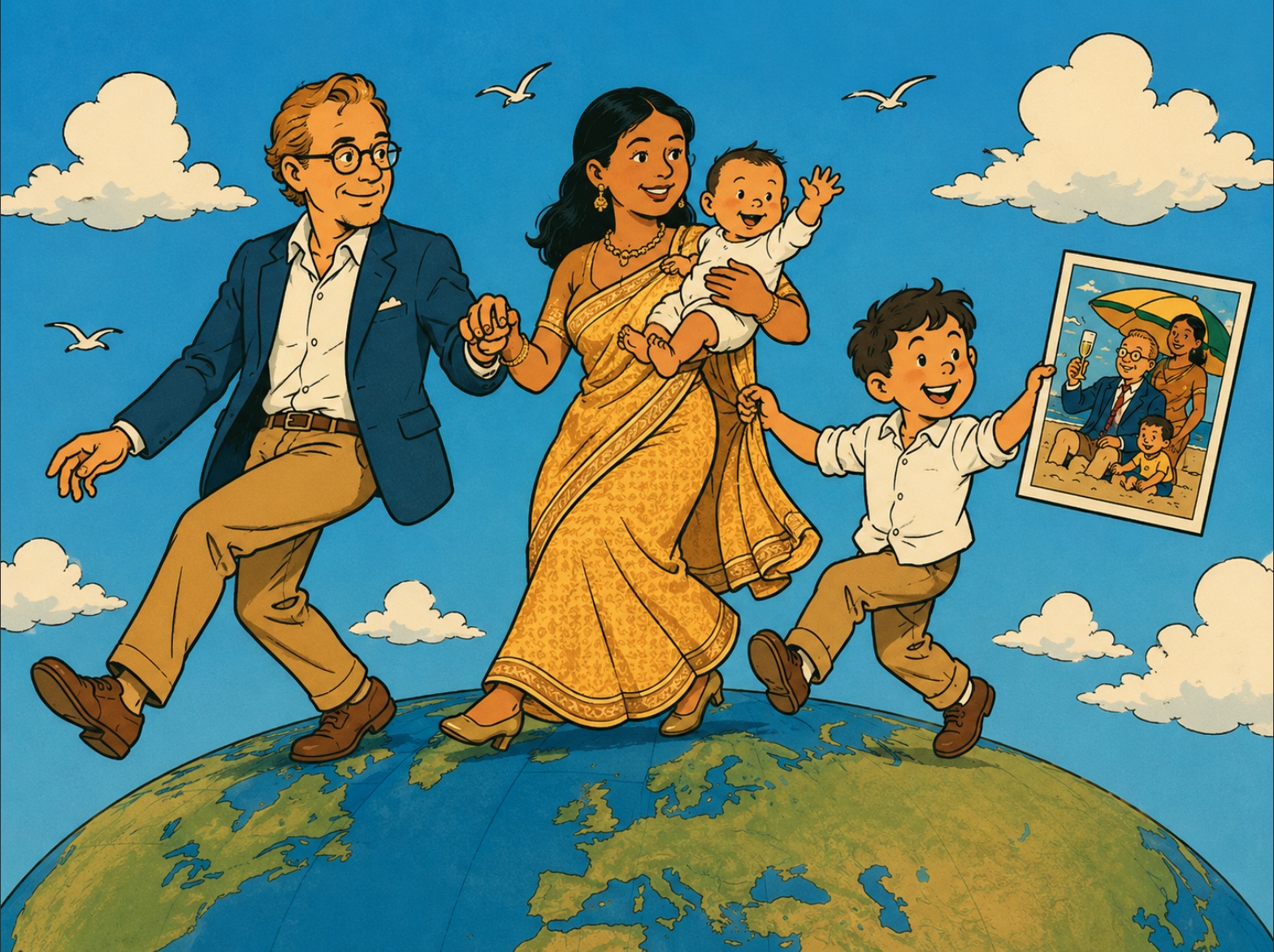
A three-year-old son. Another child on the way. Three languages spoken at home. A family consciously trying to create distance from a world increasingly consumed by nervousness, superficiality, and collective confusion.
Some people call it late.
I call it anti-cyclical.
Because while large parts of Western society speak endlessly about limitation, decline, and permanent crisis, a different thought emerged in my mind: perhaps real responsibility lies precisely in passing life forward — not merely biologically, but culturally, emotionally, and intellectually.
Not every young person automatically possesses maturity.
And not every older person automatically loses relevance or vision.
Quite the opposite.
With age comes something modern societies dramatically underestimate: judgment. Calmness. Pattern recognition. The ability to distinguish hysteria from reality. Anyone who has spent decades carrying responsibility, building businesses, surviving crises, processing setbacks, and navigating real life develops a fundamentally different perspective on the world.
And there is something else that comes with time: the accumulation of experience.
A person does not merely carry memories after decades of life. He carries patterns. Experiences of success and failure. Resistance and perseverance. Responsibility. Discipline. Resignation — or the conscious refusal to surrender to it.
Perhaps this is also one of the most fascinating ideas surrounding modern epigenetics: that life experiences do not simply disappear without leaving traces.
Someone who has spent decades building stability, overcoming crises, solving problems, and enduring pressure changes not only psychologically, but also the entire emotional atmosphere surrounding the next generation. Experiences shape stress responses, decision-making, emotional regulation, resilience, and ultimately the environment in which children grow up.
Success is rarely accidental.
It is usually the sum of many factors: endurance, adaptability, discipline, risk tolerance, emotional resilience, and the ability to continue despite setbacks.
And perhaps this is precisely what modern societies prefer not to discuss: children inherit far more than eye color or material wealth. They grow up inside the emotional and intellectual ecosystems of their parents.
Inside their calmness.
Or their anxiety.
Inside their clarity.
Or their confusion.
My son is growing up trilingual — not as a prestige project, but because language expands horizons. Because cultural flexibility may become a form of protection in an increasingly unstable world.
Far away from the dystopian permanent agitation that has become normal in many places, we are consciously trying to build an environment centered around education, inner stability, curiosity, and independence of thought.
That is why I do not see late fatherhood as nostalgia.
I see it as a conscious decision.
Perhaps a person in later stages of life can pass on something increasingly rare in modern societies: stability, perspective, and the ability to separate artificial noise from reality.
Family as a counterbalance.
Education as resistance.
Calmness as strength.
Perhaps cultural renewal will not begin in parliaments or television studios.
Perhaps it will begin again at the kitchen table.