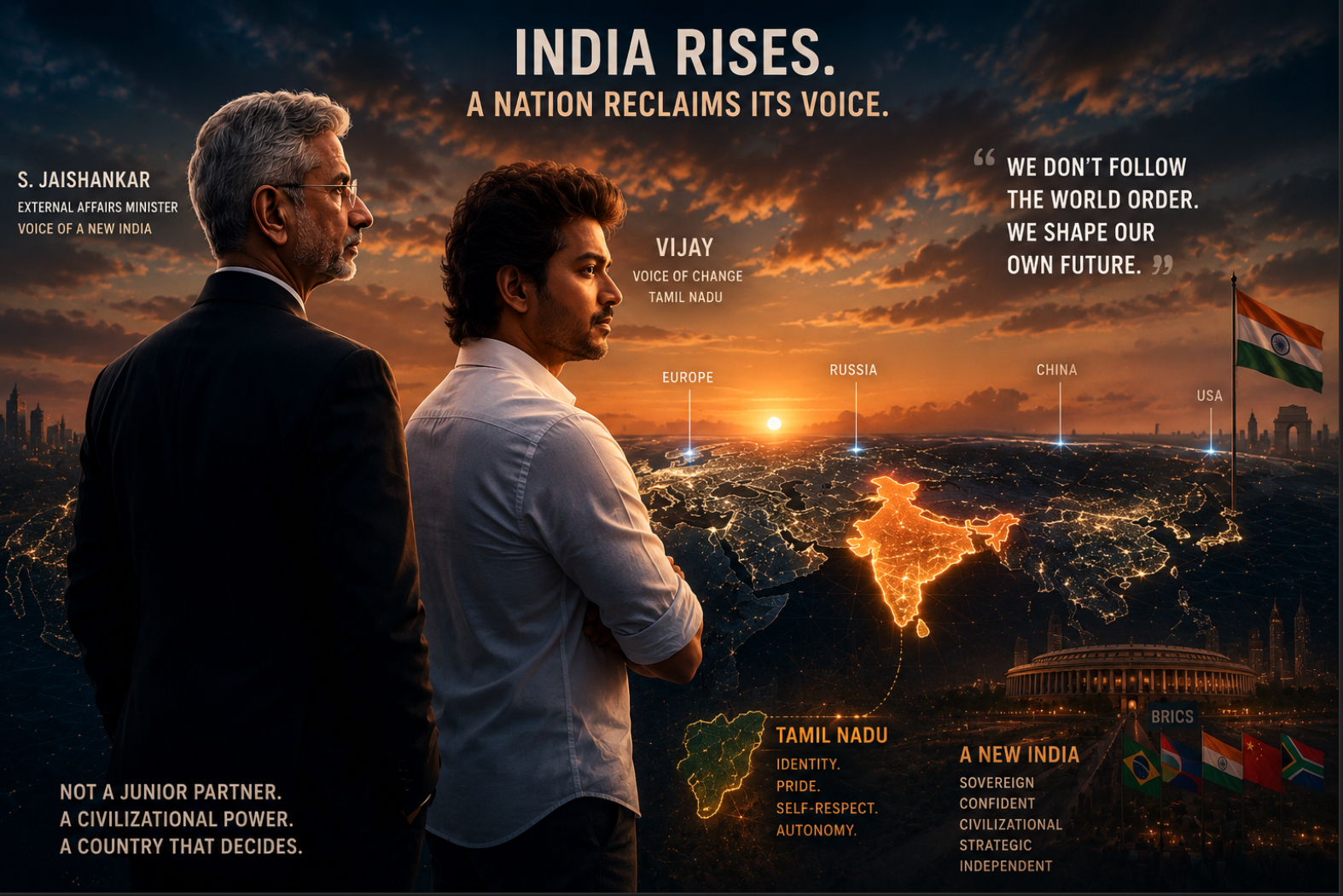
Geopolitical Turning Point: Why India Is No Longer the Junior Partner
Posted on May 24th, 2026
After almost two decades connected to India, I learned one fundamental truth: political systems rarely collapse overnight. They slowly erode — until a moment arrives when resistance becomes socially legitimate, visible, and eventually powerful enough to reshape the structure itself.
That moment now appears to be unfolding globally.
India is currently experiencing a remarkable transformation. With the political rise of C. Joseph Vijay, new political momentum is emerging outside long-established power structures. At the same time, India has already begun redefining its geopolitical identity on a much larger scale.
This shift is particularly embodied by S. Jaishankar. India’s Foreign Minister increasingly represents a nation that no longer presents itself as a manageable developing country seeking validation from the West, but as a self-aware civilizational power with its own strategic interests, language, and geopolitical direction.
And that is the real turning point.
India speaks differently today.
More assertively.
More strategically.
More independently.
Only a few years ago, India was still widely perceived through the lens of outsourcing, cheap labor, bureaucracy, and dependency. Today, the country positions itself differently — economically, diplomatically, militarily, and psychologically.
India no longer behaves like a geopolitical junior partner.
And this transformation is not happening in isolation.
In the United States, we are witnessing major political counter-movements against entrenched establishments and ideological governance models. Across Europe, political landscapes are shifting as well — from Viktor Orbán in Hungary to growing political realignments in Italy, Austria, and increasingly Germany.
The real question therefore is no longer whether societies are changing.
The real question is:
Are we witnessing the beginning of a structural global resistance against old political, media, and economic power centers?
More and more people feel that political decisions are increasingly detached from everyday societal realities and instead shaped by transnational networks, economic interests, and elite-driven ideological frameworks.
This is why debates surrounding Agenda 2030 and institutions such as the World Economic Forum have become emotionally charged symbols far beyond their original policy context. For many, they represent a growing fear of centralization, loss of sovereignty, and societal disconnection.
Whether those fears are entirely justified is almost secondary at this stage.
What matters is that they have become politically effective.
Perhaps we are not merely witnessing another cycle of protest politics.
Perhaps we are witnessing the re-emergence of sovereign societies attempting to reclaim strategic control over their own futures.
And perhaps India is not the follower in this new era —
but one of its earliest indicators.