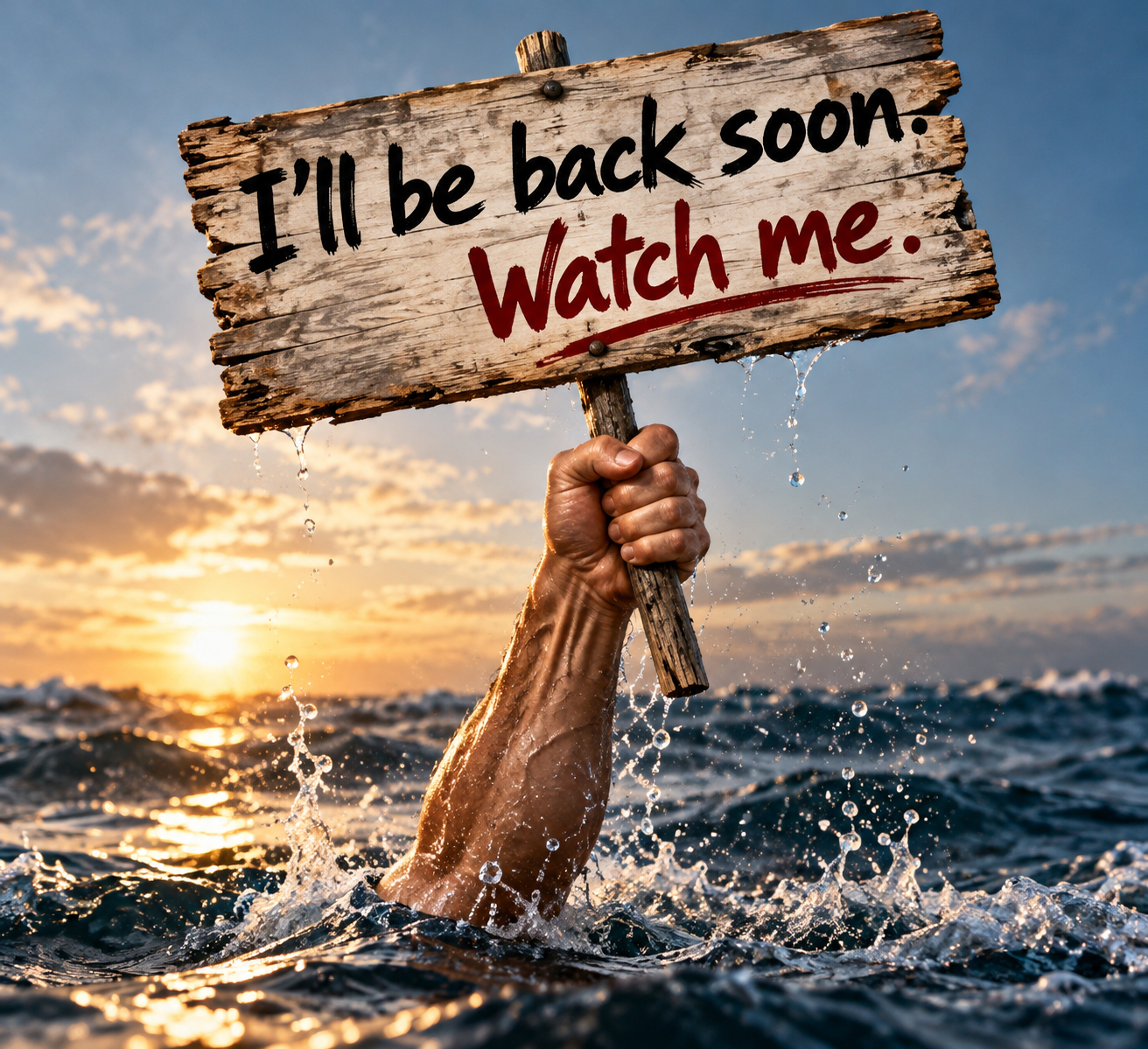
The Will Not to Go Under
Posted on October 10th, 2013
On Human Determination, the Limits of Willpower, and the Humility of Success
The Limits of Human Will
Recently, I watched a film about a sixteen-year-old girl who sailed alone around the world. For some 270 days, she faced the oceans, unpredictable weather, isolation, and the uncertainty that accompanies any undertaking whose outcome cannot be guaranteed. Behind her stood parents and friends who believed in her ambition, even as they understood the risks.
What stayed with me was not simply her courage. It was the quiet audacity of believing that an extraordinary undertaking might be possible, and then accepting everything that such a belief demands.
The film awakened memories of two experiences from my youth. Both involved windsurfing, open water, and a confidence in my own abilities that, with the benefit of hindsight, was not always justified.
Neither experience was particularly heroic. Both contained a generous measure of youthful recklessness. Yet they remained with me, long after the physical exhaustion and immediate danger had faded.
Perhaps because, on both occasions, I came remarkably close to discovering what it really means to go under.
When the Storm Became Stronger Than My Will
The first experience took place on Lake Steinhude in Germany.
It was a cold day, with an air temperature of approximately twelve degrees Celsius. A storm warning was in effect, and powerful winds drove substantial waves across the lake. For a young windsurfer, however, such conditions were less a deterrent than a temptation.
I was riding a sinker, a low-volume board designed for strong winds, carrying a 5.2-square-metre sail. Fast and responsive when moving, the board offered precious little buoyancy when stationary.
Approximately one and a half to two kilometres offshore, the power joint connecting the rig to the board broke.
Within seconds, the exhilaration of sailing gave way to an altogether different reality.
My old inflatable drysuit began leaking. Water seeped inside, adding weight and drawing warmth from my body. The waves made every movement exhausting, while neither board nor sail offered sufficient buoyancy to support me reliably.
I was cold, increasingly tired, and a considerable distance from shore.
And yet my immediate concern was not exclusively my survival.
It was my equipment.
The board and sail had each cost approximately 800 Deutsche Marks. Together, they represented a small fortune to a young man who had worked hard to afford them.
Should I abandon the board or the sail?
I could not bring myself to sacrifice either.
So I held on.
The waves continued, the cold intensified, and my strength gradually diminished. Somewhere between calculation and stubbornness, I remained determined to save everything, even as the circumstances increasingly suggested that I might lose it all.
Eventually, the rescue service appeared.
A friend on shore had noticed that I was still somewhere out on the lake, although my sail had disappeared from view. Sensing that something was wrong, he raised the alarm.
The rescuers took me aboard.
And, to my considerable satisfaction, they brought both the board and the sail with me.
I had lost nothing.
My life. My board. My sail.
I had gambled heavily. And once again, I had won.
Or so it seemed.
For beneath that apparent triumph lay an uncomfortable truth: I knew that I would not have made it back to shore on my own.
My determination had kept me holding on. It had not brought the rescuers.
A friend had noticed. Someone had acted. Others had come.
Looking back, I sometimes think of that sequence as something approaching divine providence. Whether one calls it providence, fortune, or the timely intervention of others matters less than the recognition that my fate had ceased to be entirely in my own hands.
At the time, I was simply relieved, and rather pleased to have saved my equipment.
Only later did I understand the distinction between a fortunate outcome and a wise decision.
I had gambled and won. But winning did not mean that I had been right.
When There Was Not Enough Wind
My second encounter with the limits of my abilities took place on the Costa del Sol in Spain.
This time, there was no storm, no freezing water, and no broken equipment. Instead, there was Mediterranean sunshine, a pleasant coastline, and the agreeable conviction that life ought not to be taken too seriously.
After two caipirinhas, I decided to windsurf across four or five kilometres of open water to another bay, where I intended to enjoy a coffee, perhaps another cerveza, before returning.
It seemed an entirely reasonable plan.
Once again, I was riding a sinker. This time, without a harness.
The wind, however, had other ideas.
It began to weaken, while a current gradually carried me away from my intended course. Without sufficient wind, maintaining momentum became increasingly difficult. Each unsuccessful attempt to regain my position required another waterstart, lifting the sail from the water and using the wind to pull myself back into motion.
The first four went reasonably well.
The fifth demanded considerably more effort.
By the sixth, the wind appeared to have suspended its services altogether.
My earlier caipirinhas had undoubtedly increased my enthusiasm for the undertaking. Unfortunately, they had not improved my seamanship in anything like the same proportion.
The sinker offered little support beneath me. My arms, deprived of the assistance of a harness, absorbed every effort. The current continued its indifferent work.
Gradually, my forearms began to swell. My hands cramped, and the repeated attempts to lift the sail consumed what remained of my strength.
I was kilometres offshore.
What had begun as an excursion for coffee was becoming a struggle to return alive.
Unlike Lake Steinhude, however, there would be no rescue service.
Nobody had noticed that I was missing.
My two friends were still enjoying themselves at the beach bar, figuratively drowning in their caipirinhas, while I was confronting a rather more literal possibility of going under.
Eventually, I reached a point where further effort seemed not merely futile but dangerous.
I could not force the wind to return. I could not stop the current. And my exhausted muscles had ceased to respond to the demands I placed upon them.
Yet I remember, with surprising clarity, what I told myself.
Stay calm. Stay calm. Let yourself drift. Rest. The wind will come back.
There was no guarantee that it would. Nor could I know how far the current might carry me in the meantime.
But I knew that panic would achieve nothing.
So I stopped struggling.
I gathered myself on the board as best I could, steadied my breathing, and allowed my arms to recover. The sea continued to move around me, indifferent to my predicament.
For a while, I could do nothing but wait.
And then, gradually, the wind returned.
Not dramatically. Not as though answering a prayer.
Just enough.
Enough to attempt another waterstart, bring the sail under control, and begin moving towards shore.
My hands were so exhausted that I sometimes held the boom in the crooks of my elbows, unable to maintain a proper grip.
But I was moving.
After approximately three and a half to four hours, I reached a safe stretch of coastline.
No rescuers. No welcoming committee. Not even the satisfaction of having been missed.
Only the immense relief of standing on solid ground.
I had returned through my own efforts, although not through effort alone. The wind had returned, too.
What remained most vividly in my memory was not the physical struggle, but the strange clarity that had accompanied my exhaustion.
When almost everything else had failed me, I had managed to remain calm.
The Quiet Strength of a Clear Mind
Years later, I began to recognise something of that experience in circumstances that had little to do with the sea.
In professional life, crises rarely announce themselves with the clarity of a storm warning. They emerge through conflicting interests, financial pressures, institutional uncertainty, or decisions whose consequences are impossible to calculate fully in advance.
I encountered such situations while establishing and developing educational institutions, negotiating change, and assuming responsibility for organisations whose future depended on decisions made under pressure.
And I noticed something about myself.
The more unsettled the circumstances became, the calmer I often grew.
Where others sometimes responded with urgency bordering on panic, I found myself becoming increasingly attentive to what actually mattered.
What was happening? What could be influenced? Which decision was necessary, and which merely served the desire to appear decisive?
I do not suggest that I always found the right answers. I have made mistakes, misjudged circumstances, and occasionally mistaken confidence for wisdom.
But I had learned to distrust the impulse to act merely because inaction felt uncomfortable.
On the Costa del Sol, another desperate waterstart might have exhausted my remaining strength. Waiting had seemed intolerable, yet it had preserved my ability to act when conditions changed.
That memory returned to me more than once.
Leadership is often associated with movement, decisiveness, and the visible exercise of authority. Yet some of its most consequential moments are almost invisible: a measured response, a question asked before a conclusion is reached, or the refusal to let collective anxiety determine the next decision.
Calmness is not the absence of fear.
It is the discipline of preventing fear from becoming the author of our decisions.
I did not learn at sea that I could control every crisis. I learned that I did not have to allow every crisis to control me.
My Grandfather and the Inheritance of Determination
Long before those encounters with the sea, however, someone had already planted in me a profound belief in the power of determination.
My grandfather.
He was a man who refused to regard the circumstances of his life as a final verdict on what he might achieve. Largely self-educated, he developed into a lecturer and taught himself to play the clarinet, eventually reaching a remarkable level of musical accomplishment.
My father, influenced by that example, began playing the clarinet at the age of five or six and went on to build a successful musical career of his own.
Yet what I remember most clearly is neither the music nor the professional achievement.
It is something my grandfather once told me.
“If you really want something, you can achieve it. I am the best example. I accomplished something that others could not.”
He spoke with the conviction of someone who had tested those words against his own circumstances.
For a young boy, that made all the difference.
His belief was not that life would readily accommodate our ambitions. It was that the boundaries others considered permanent might, through determination and effort, prove movable.
I carried that conviction into adulthood.
When I helped establish an international school in India from the ground up, following an initiative of the German Federal Foreign Office, there were many occasions when the distance between ambition and reality appeared formidable.
Building an institution meant confronting uncertainty, competing expectations, organisational challenges, and the countless practical obstacles that rarely feature in the original vision.
Later, when we moved from the school’s initial German educational model towards an international Cambridge curriculum, I encountered another lesson: perseverance does not always mean preserving the original course.
Sometimes the ambition must remain, while the route towards it changes entirely.
My grandfather had taught me that the will could move boundaries.
Life gradually taught me that wisdom also lies in recognising which boundaries to challenge, which to respect, and which to approach from another direction.
The will gives us direction. Judgment determines the path.
The Humility of Success
We live in a world that celebrates determination with almost religious enthusiasm.
Never give up. Push harder. Believe in yourself.
There is something appealing about such declarations. They offer the reassuring impression that success is ultimately a matter of sufficient effort.
Yet experience suggests a less convenient truth.
We can make every effort and still fail. We can make foolish decisions and emerge unharmed. We can succeed because another person notices what we have overlooked, or because circumstances change at precisely the moment when our own resources are exhausted.
This does not diminish the importance of personal responsibility. It simply acknowledges that the world does not exist solely to reward our determination.
Nor should we confuse resilience with an appetite for unnecessary danger.
My youthful adventures were hardly examples of prudent judgment. I would not recommend repeating them, least of all under the influence of caipirinhas.
Nevertheless, I remain convinced that people develop inner strength partly through experiences in which their abilities are genuinely tested.
In our understandable desire to protect the next generation, we sometimes risk removing not only danger but also the opportunity to encounter difficulty, make mistakes, and discover the resources needed to overcome them.
The purpose of education cannot be to manufacture hardship. But neither can it be to construct a world in which every obstacle is removed before it can be encountered.
Life will eventually present its own uncertainties.
The question is whether we have learned to meet them with courage, composure, and judgment.
What Remains
Looking back, I recognise three influences that have accompanied me throughout my life.
My grandfather gave me the conviction that determination can move boundaries once thought immovable.
Lake Steinhude taught me that determination has limits, and that our survival may depend on the attention, courage, and generosity of others.
The Costa del Sol taught me that when physical strength is exhausted, the ability to remain calm may preserve the possibility of finding a way forward.
I still believe deeply in the power of human will.
Without it, many worthwhile ambitions would never advance beyond imagination. Institutions would remain unbuilt, difficulties unchallenged, and opportunities unexplored.
But I no longer mistake determination for invulnerability.
Sometimes we must fight. Sometimes we must change course. Sometimes we must wait. And sometimes we must accept the hand extended by another human being.
The difficulty lies in knowing which moment calls for which response.
The young man on Lake Steinhude believed that saving everything was a victory. The young man off the Costa del Sol discovered that remaining calm could be more valuable than struggling without direction.
The older man looking back understands how much both owed to circumstances beyond his control.
I was fortunate that a friend noticed something was wrong. Fortunate that rescuers arrived. Fortunate that the wind returned.
And fortunate, perhaps, that I lived long enough to recognise the difference between determination and wisdom.
Willpower may be a prerequisite for success. But humility and gratitude determine its human worth.