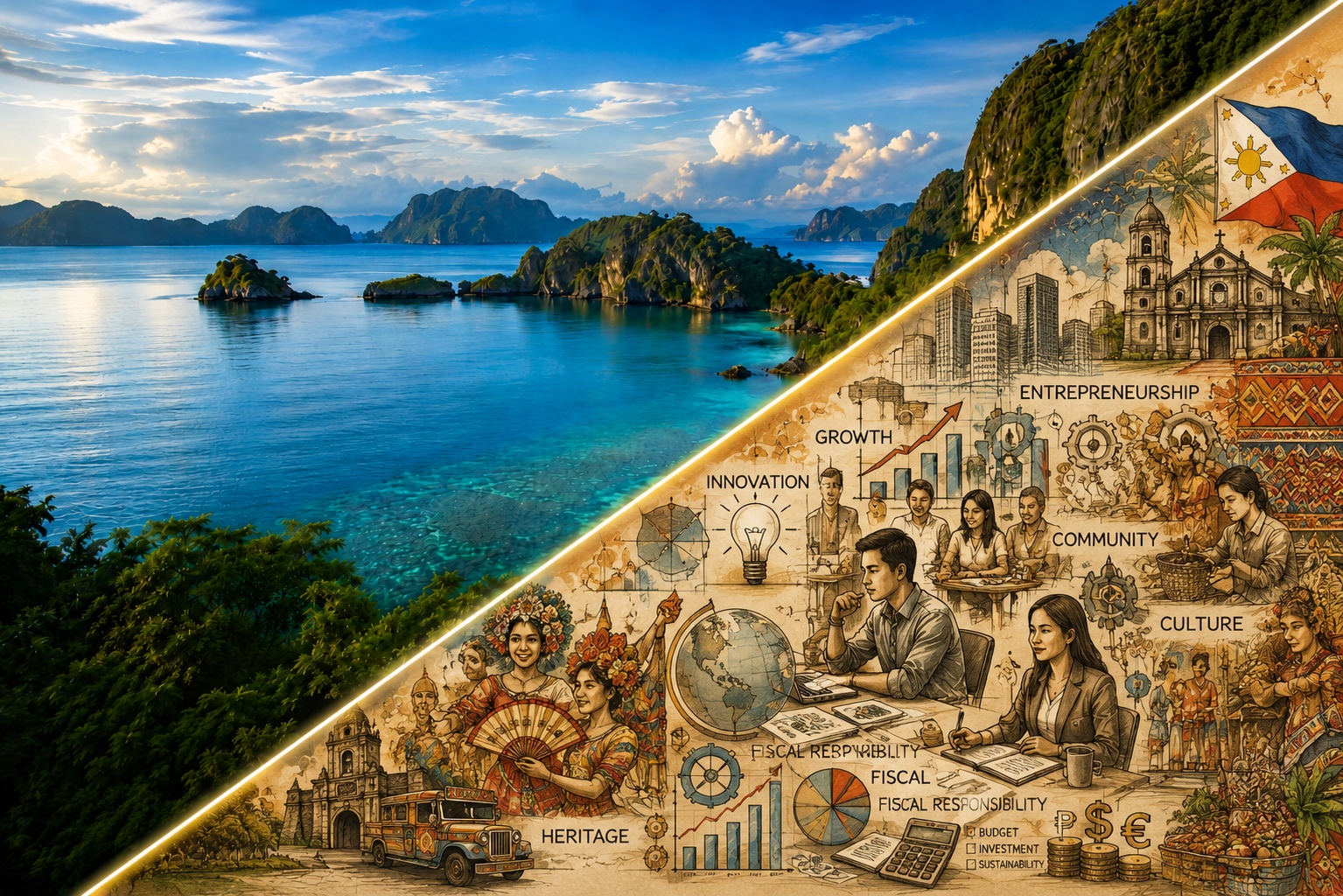
The Philippines: Between Worlds, Yet Entirely Its Own
Posted on July 16th, 2026
There are countries one visits, appreciates and eventually files away among the many impressions accumulated through travel. And then there are places that return to one’s attention — sometimes years later — because they appear differently when viewed through the lens of experience.
For me, the Philippines increasingly belongs to the second category.
Having travelled in the country before, I have recently found my attention drawn back to the archipelago in a different way. Perhaps this has something to do with having spent a substantial part of my professional and personal life in Asia. The longer one lives between cultures, the less convincing the usual geographical classifications become. “Asia”, after all, is not a culture. Nor is Southeast Asia a single cultural space.
And the Philippines illustrates this particularly well.
At first sight, the country seems almost familiar to many Europeans. Christianity, widespread use of English, centuries of European influence and a long American presence create points of reference that appear recognisable. Yet beneath that apparent familiarity lies a society that remains profoundly Asian in its relationships, family structures, sense of community and social instincts.
It is precisely this combination that makes the Philippines so fascinating.
A Country Between Cultural Worlds
Few societies can be adequately understood through a single historical narrative, but this is particularly true of the Philippines.
Long before European colonisation, the islands were part of extensive Asian networks of commerce, migration and cultural exchange. Spanish rule subsequently left a deep imprint on religion, language, architecture and social institutions. American influence later added another layer, particularly in education, administration, popular culture and the widespread use of English.
Yet describing the Philippines simply as an Asian country with Spanish and American influences would miss something essential.
Cultures do not merely accumulate influences like layers of paint. They absorb them, reshape them and eventually create something new.
What emerged in the Philippines is therefore neither an imitation of Europe nor an Asian version of America. It is something distinctly Filipino.
That distinction matters.
From a European perspective, there is sometimes a temptation to interpret familiarity as similarity. Because communication may appear relatively easy and certain cultural references are recognisable, outsiders may initially assume that the Philippines operates according to broadly Western social codes.
It does not.
Relationships, family loyalties, respect, community and personal trust often carry a significance that cannot be understood through purely institutional or transactional thinking. Like many societies across Asia, relationships frequently precede structures.
For anyone intending to live or work internationally, this distinction is fundamental.
Successful international engagement begins not with the assumption that one’s own system travels well, but with the willingness to understand why another society functions as it does.
An Underestimated Part of Asia
European attention toward Asia tends to follow familiar routes.
China dominates geopolitical discussion. Singapore is associated with efficiency and international business. Japan continues to fascinate through technology and culture. India commands attention through its scale, economic development and extraordinary diversity.
The Philippines often occupies a less clearly defined position in the European imagination.
For some, it is primarily associated with beaches and tourism. For others, with overseas Filipino workers or the enormous Filipino diaspora. Both are legitimate parts of the country’s story, but neither comes close to describing the whole.
There is a far more interesting story to be told.
The Philippines possesses an unusual combination of cultural openness, international orientation, educational aspiration and strong communal identity. It occupies a geographical and cultural position that connects several worlds without being reducible to any of them.
In my view, this makes the country one of the more underestimated societies in Southeast Asia.
And perhaps particularly underestimated in Europe.
Education as a Window into Society
One of the most revealing ways to understand a society is to look at the way it thinks about education.
Schools are never simply places in which mathematics, languages or science are taught. They are also places where societies negotiate questions of identity, aspiration, authority, community and the future.
This becomes particularly interesting in internationally oriented societies.
The Philippines has long been connected to global educational traditions while simultaneously maintaining deeply rooted local values. International schools, universities and educational institutions therefore operate within a particularly rich cultural environment.
But international education should never mean the simple export of an external model.
The strongest schools I have encountered during my years working internationally have always understood that distinction.
An international school should provide global academic standards while remaining genuinely connected to the society in which it operates. Its purpose is not to construct an educational island separated from its environment. It should instead become a bridge: between cultures, between local and international communities, and between established traditions and future possibilities.
That is particularly relevant in countries such as the Philippines.
The educational opportunity lies precisely in the meeting of these worlds.
Students can grow up with a strong sense of their own cultural identity while simultaneously acquiring the confidence and intellectual flexibility to operate internationally. These two ambitions are not contradictory.
On the contrary, one often strengthens the other.
What Europeans Can Learn
When Europeans discuss moving to Asia, the conversation frequently revolves around what a particular country can offer them.
Quality of life. Climate. Career opportunities. Cost of living. International schools. Housing. Infrastructure.
All of these questions are understandable.
But perhaps there should be another question as well:
What can we contribute to the communities we enter?
International mobility becomes much more interesting once it moves beyond consumption.
Living abroad should ideally be an exchange of knowledge, experience and perspective. Someone arriving with professional experience should naturally bring ideas and expertise. But that person should equally arrive prepared to listen.
This may sound obvious. In practice, it is one of the central challenges of international leadership.
Experience gained in Frankfurt, London, Singapore, Chennai or New York can be valuable in Manila. But it does not automatically become relevant simply because it worked elsewhere.
Ideas must travel with humility.
International experience becomes useful only when it is capable of adapting itself to another cultural environment.
That principle applies particularly to education, where institutions are inseparable from the communities they serve.
Beyond the Expatriate Bubble
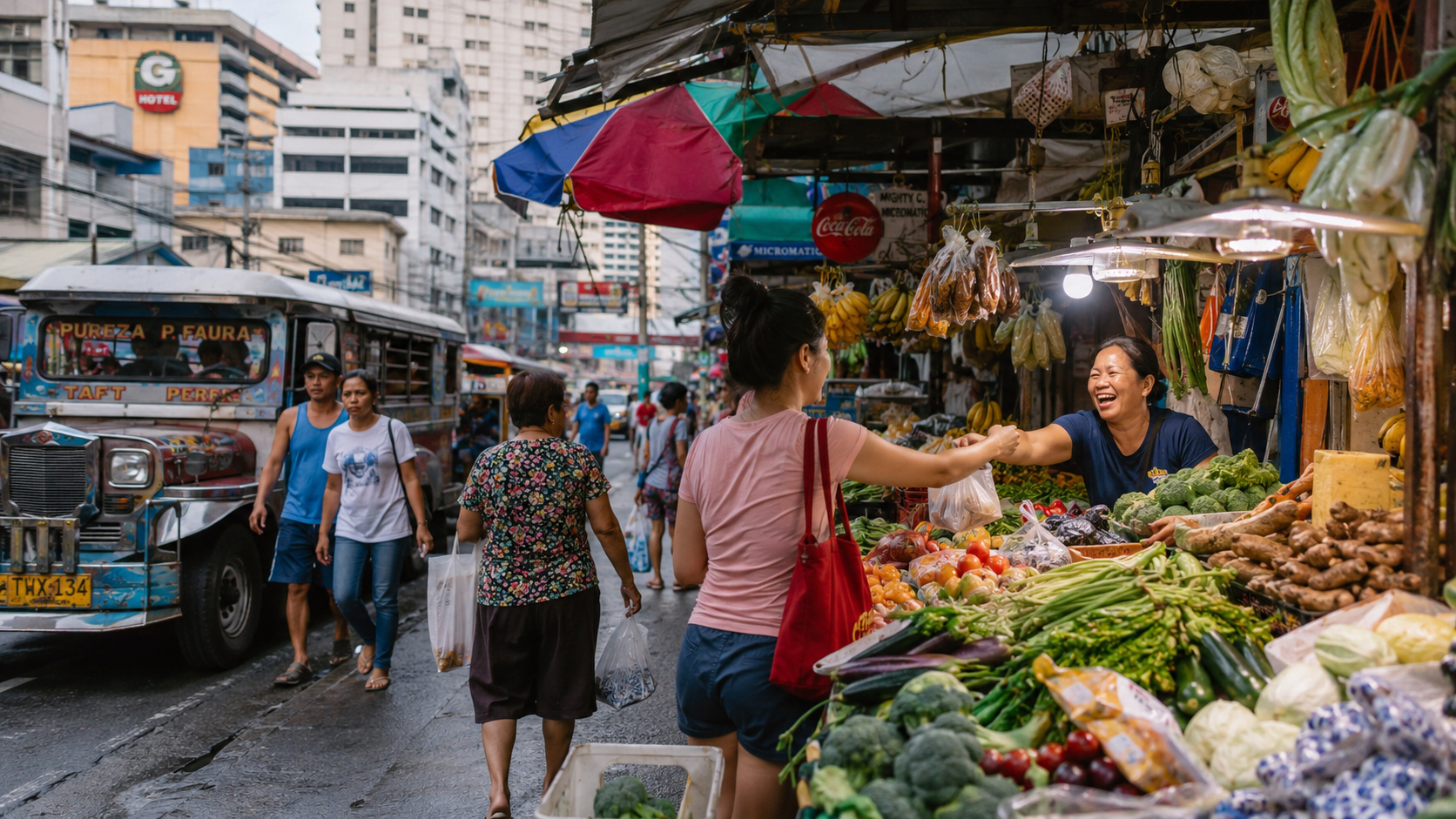
There is another reason why the Philippines deserves greater attention from internationally mobile Europeans.
For decades, expatriate life in many parts of the world developed around relatively insulated communities. People moved abroad professionally while maintaining social environments that often resembled the countries they had left.
That model increasingly feels outdated.
The more meaningful form of international life is not separation but participation.
Learning how a community thinks. Understanding its traditions. Listening before prescribing. Building relationships beyond professional circles. And accepting that living abroad should change the person who arrives just as much as that person hopes to contribute professionally.
The Philippines appears particularly interesting from this perspective because community itself occupies such a central place in social life.
For an outsider, this represents both an invitation and a responsibility.
One can remain an observer.
Or one can gradually become a participant.
The second option requires more effort, but it is also where international experience becomes genuinely valuable.
Why the Philippines Has Returned to My Attention
Having spent many years living and working across Asia, I no longer find myself particularly interested in countries merely because they are new.
Novelty is overrated.
What becomes more interesting with time are places that possess depth — places in which several cultural, historical and social currents meet and create something that cannot immediately be categorised.
The Philippines increasingly strikes me as such a place.
There is familiarity, but also difference.
There is an unmistakable openness to the wider world, yet also a powerful sense of family and community.
There are strong Western historical influences, yet an identity that remains unmistakably Asian and unmistakably Filipino.
Perhaps that is why the country has recently returned to my attention.
Not simply as a destination, but as a cultural space worth understanding more deeply.
And perhaps that is ultimately the most interesting form of travel.
Not the movement from one country to another, but the moment when curiosity becomes engagement.
At a certain point in an international life, the question changes.
It is no longer merely:
Where could I live?
or:
Where could I work?
The more interesting question becomes:
Where might accumulated experience become meaningful — while still leaving enough to learn?
The Philippines, I suspect, may be one of those places.